Where Fishin Frenzy Free Play Stops and the Risk Starts
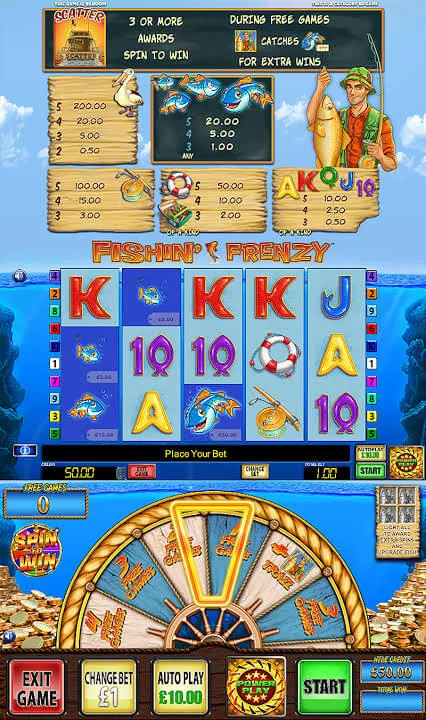
You tap «Demo» on a Fishin Frenzy listing, the reels spin, fish symbols land, and a balance ticker in the corner reads £100.00. No card asked for, no account opened yet. The scatter drops three times, the free-spins round triggers, the multipliers stack — and your demo balance climbs to £247.80. Then you hit the «Play for Real» button, and everything changes: the bet picker now caps at £5.00 if you're over 25 (£2.00 if you're 18–24, under UKGC stake limits), the balance is your actual money, and the withdrawal flow that the demo never mentioned suddenly requires document upload and a 24–48-hour wait.
This page walks through what Fishin Frenzy free play actually reveals, what it hides until you deposit, and the lowest-risk route into real-money play on UKGC-licensed operators serving the United Kingdom. The demo teaches the trigger pattern and the volatility curve; it doesn't prepare you for affordability checks, wager requirements on bonuses, or the time lag between a big win and cash hitting your bank. If you're trying to work out whether this game suits a cautious budget, here's where the demo ends and the real friction starts.
What the Demo Session Actually Shows
Most UKGC-licensed operators serving British players run Fishin Frenzy demo directly in the browser — no download, no registration wall on many sites, though some ask you to log in to confirm age before unlocking free play. You load the game, pick a stake from the same range you'd see in real-money mode (usually £0.10, £0.20, £0.50, £1.00, £2.00, up to £5.00), and the reels spin on a fictional balance of £100.00 or £1,000.00. The RTP sits at 96.12% in both modes; the maths engine behind the scatter triggers, the free-spins multipliers, and the base-game hit frequency is identical. The demo doesn't use a separate, looser RNG — that would breach UKGC technical standards and cost the supplier its certificate.
What you learn in a 20-minute demo session:
- The free-spins trigger rate — three or more fisherman scatter symbols, landing roughly once every 80–120 spins in medium-volatility maths.
- The prize-multiplier mechanic inside the bonus round: each fish symbol reveals a multiplier (2× to 5× your stake), and the fisherman collects them all before the spins run out.
- The base-game pace: Fishin Frenzy runs at about 3–4 seconds per spin on default autoplay, faster if you tap turbo mode. Over 100 spins at £1.00 each, you'll see the balance swing £20–£40 either side of the starting point, punctuated by the occasional £30–£80 scatter win or a dead stretch of 15–20 losing spins.
- The stake picker's real range, capped at £5.00 for players aged 25 and over, and £2.00 for those aged 18–24 under the UKGC's online-slot stake limits introduced to reduce harm.
The demo balance resets whenever you refresh the page or drop below zero, so you can test aggressive stake jumps — doubling from £0.50 to £1.00 after a losing run, for instance — without actual loss. That freedom is the demo's edge: you map out the game's volatility curve and trigger cadence before risking a penny.
The Parts of Real Play the Demo Never Mentions
The demo hides three layers of friction that only appear once you deposit. First: KYC and withdrawal timing. The UKGC requires operators to verify age and identity before you can deposit, and full document checks (passport, utility bill, sometimes a selfie) before your first withdrawal clears. A £200.00 win in demo mode vanishes with one click; a £200.00 real-money win triggers a 24–48-hour KYC queue, then another 1–3 working days for the funds to reach your bank via Faster Payments or back to your debit card. If the operator flags an affordability concern — cumulative net deposits above £150.00 a month now prompt a soft check using credit-reference data — your withdrawal pauses until you provide payslips or bank statements.
Second: bonus wagering. Many British players switch to real money via a welcome offer — say, 50 free spins on Fishin Frenzy or a 100% deposit match up to £100.00. The demo shows the free-spins mechanic as pure upside; the real offer attaches a 35× or 40× wagering requirement. A £50.00 bonus becomes £1,750.00 to £2,000.00 of turnover before you can withdraw a penny of the winnings. Miss that detail, and a £120.00 balance after the bonus spins feels like profit — until you check the account screen and see «£1,340.00 wagering remaining».
Third: the psychological shift from fake balance to real loss. In demo mode, a £40.00 losing streak is a data point; in real money, it's £40.00 gone. The urge to chase — doubling the stake, firing 50 fast spins to trigger the bonus — hits harder when your own funds are draining. The demo can't simulate that pressure, and it's the main vector for harm in medium-volatility slots like Fishin Frenzy, where scatter droughts of 150+ spins do happen within the RTP's normal distribution.
Demo on Mobile and Whether You Need an Account
Fishin Frenzy demo runs in mobile browsers (Safari on iOS, Chrome on Android) without an app install. Some UKGC-licensed operators let you tap «Demo» on the game tile and play immediately; others show a registration prompt first, asking for date of birth and postcode to confirm age and UK residency before unlocking free play. That gate exists because the Gambling Act technically classes free-play slots as advertising if they're accessible to under-18s, so operators with a cautious legal team restrict demo access to logged-in, age-verified accounts.
Once you're in, the mobile demo mirrors the desktop experience: same stake range (£0.10–£5.00, or up to £2.00 if you registered with an 18–24 date of birth), same balance ticker, same autoplay and turbo controls. The screen real estate shrinks the paytable and settings menu into tap-to-expand drawers, but the maths and trigger frequency stay identical. A 100-spin demo session on a phone uses about 15–20 MB of data; if you're on a metered connection, that's negligible, but worth noting if you're testing multiple slots back-to-back.
The account requirement cuts both ways: it adds a step before you can try the demo, but it also saves your session. Log in once, and the operator remembers your age-verification status across devices. Switch from phone to laptop mid-session, and the demo balance persists — useful if you're methodically tracking how often the free spins land over a 500-spin sample.
How the Real Bet Range Compares to the Demo Picker
The demo's stake picker shows the exact range you'll see in real money, with one critical filter: the UKGC's age-based cap. If you're 25 or over, the top stake is £5.00 per spin; if you're 18–24, it's £2.00. That limit applies across every UKGC-licensed slot — Fishin Frenzy, Starburst, Book of Dead, all of them — and the operator's platform enforces it at account level, not game level. Register with a date of birth that puts you in the 18–24 bracket, and the bet picker in both demo and real mode tops out at £2.00, no exceptions.
The lower end of the range starts at £0.10, which suits a cautious first deposit of £10.00–£20.00: you can fire 100–200 spins and map the volatility without exhausting your balance in five minutes. At £0.10, the maximum single-spin win (five premium fish symbols across a payline) pays about £8.00–£10.00; at £5.00, the same combination hits £400.00–£500.00. The free-spins round scales the same way: a strong bonus (10 spins, multiple 5× multipliers) might return 50× to 100× your triggering stake, so £5.00 at £0.10 or £250.00–£500.00 at £5.00.
Demo play lets you test whether £0.10 feels too slow (wins are tiny, scatter triggers feel distant) or £2.00 feels too fast (balance swings £50–£80 in 30 spins). Most British players on a controlled budget settle around £0.20–£0.50 for the first real-money session, then adjust based on how quickly the free spins arrive and how deep the losing runs go between them.
The Lowest-Risk Path from Demo to Deposit
If the demo convinces you Fishin Frenzy's trigger cadence suits your tolerance for scatter droughts, the safest entry into real money follows three steps: pick a UKGC-licensed operator (check the register at gamblingcommission.gov.uk and match the licence number in the site footer), deposit the minimum needed to test the game (£10.00–£20.00 via debit card, PayPal, or Open Banking — credit cards have been banned for gambling in the UK since 2020), and skip the welcome bonus if you're not comfortable with wagering requirements.
That last point is the friction most demo players miss. A 100% match up to £50.00 sounds like free money, but the attached 35× wager means you must turn over £1,750.00 (your £50.00 deposit plus the £50.00 bonus, times 35) before any winnings become withdrawable. If your plan is to play 200 spins at £0.20, see if the free-spins round hits, and cash out if you're £20–£30 ahead, a bonus offer blocks that exit. You're locked into the wager cycle until the requirement clears or your balance drops to zero.
The lower-risk alternative: deposit £10.00 with no bonus, play at £0.10 or £0.20, and set a stop-loss of half your deposit (so £5.00). If the scatter lands and you climb to £25.00–£30.00, withdraw immediately. The first withdrawal will take 24–48 hours for KYC (passport and proof of address), but once that's done, future cashouts to the same debit card or PayPal account clear in 1–3 working days. If the scatter doesn't land and you hit your £5.00 stop-loss, you've lost less than the cost of two pints and you've learned whether Fishin Frenzy's medium volatility suits your budget.
| Approach | Deposit | Stake | Wager | Risk | |
|---|---|---|---|---|---|
| Bonus (50 spins + 35× wager) | £10.00 | £0.10 | £1,225.00 turnover required | High: locked in until wager clears | → |
| No bonus, stop-loss £5.00 | £10.00 | £0.10–£0.20 | None | Low: walk away after 50–100 spins | → |
| No bonus, full session | £20.00 | £0.20–£0.50 | None | Medium: enough spins to see 1–2 scatters | → |
Set deposit limits through your account settings before you play — the UKGC requires every operator to offer daily, weekly, and monthly caps, and you can lock them in place with a 24-hour cooling-off period so you can't lift the limit on impulse. If you're testing multiple slots or you know you're prone to chasing losses, register with GAMSTOP (gamstop.co.uk) before you deposit: one signup blocks every UKGC-licensed site for six months to five years, removing the option to chase across operators.
What Changes When You Move to Real Stakes
The maths stays the same — RTP 96.12%, same scatter frequency, same multiplier distribution in the free-spins round — but three things shift once real money is on the line. First, the pace. In demo mode, most players fire spins quickly, skip the celebration animations, and reset the balance when it drops. Real money slows the cadence: you watch the balance ticker after each spin, hesitate before raising the stake, and feel the dead stretches (15–20 losing spins) more acutely because each one is £1.00 or £2.00 gone.
Second, the exit decision. In demo, you can walk away mid-session without consequence; the balance vanishes and you restart whenever you like. In real money, walking away at £18.00 after starting with £20.00 means accepting a £2.00 loss, and the temptation to «just get back to even» drives another 20–30 spins. That's where controlled budgets break: the game's medium volatility means scatter droughts of 100+ spins sit comfortably within the RTP's normal variance, but your balance won't survive that stretch if you're playing above £0.20–£0.50 per spin.
Third, the withdrawal process. A £40.00 win in demo mode is instant; in real money, you click «Withdraw», wait for KYC (24–48 hours the first time), and then wait again for the payment to process (same day to three working days via Faster Payments or back to your debit card). If you deposited £20.00 via PayPal and you're withdrawing £35.00, the payout goes back to PayPal within a few hours once KYC clears — but if you used a debit card, expect two to three working days. That delay removes the dopamine hit of immediate reward, which is arguably protective: it's harder to chase a loss when cashouts take 48 hours to land.
The Real Limit the Demo Can't Prepare You For
The demo maps the game's maths — how often the scatter lands, how much the free-spins round typically returns, how far your balance swings between triggers. It can't simulate the psychological weight of real loss, and that's the variable that determines whether you stay in control or slide into a chase. Fishin Frenzy's medium volatility means you'll see stretches of 80–120 spins without a scatter; at £0.50 per spin, that's £40.00–£60.00 of turnover with nothing but small base-game wins to soften the drop. If your starting deposit is £50.00, one dry spell puts you at breakeven or below, and the instinct to double the stake and fire another 50 spins becomes hard to resist.
The UKGC's affordability checks add a hard ceiling: cumulative net deposits of £150.00 a month now trigger a soft check using credit-reference data, and operators must pause further deposits if the data suggests you can't afford the spend. That threshold is low by design — it's meant to catch harm early — but it also means a player who deposits £20.00 a week (£80.00 a month) can cross the line after two months if they're not withdrawing winnings to offset the inflow. The demo won't flag that; the operator's system will, mid-session, when you try to top up your balance.
If you're treating Fishin Frenzy as entertainment — a £10.00 or £20.00 session every few weeks, with the expectation that the money's gone unless the scatter lands early — the game's maths is transparent and the demo gives you a fair preview. If you're hoping to turn a small deposit into a large withdrawal, the volatility works against you: the RTP of 96.12% means the house edge grinds you down over hundreds of spins, and the free-spins round's 50× to 100× potential isn't frequent enough to offset that drain unless you stop early and walk away. The demo can't teach that discipline; it can only show you the trigger pattern and let you decide whether the wait is worth the stake.
FAQ
Do I need to register to try Fishin Frenzy demo?
It depends on the operator. Some UKGC-licensed sites let you tap «Demo» and play immediately; others ask you to create an account and verify your age (date of birth, postcode) before unlocking free play. That gate exists to comply with advertising rules under the Gambling Act, which restrict access to gambling content for under-18s. Once you're logged in, the demo runs in your browser on desktop or mobile, no download required, and your session persists across devices.
Does the demo use the same RTP and trigger frequency as real money?
Yes. The demo runs on the same 96.12% RTP and the same RNG as the real-money version — UKGC technical standards forbid suppliers from loosening or tightening the maths between modes. The free-spins trigger (three or more scatters) lands roughly once every 80–120 spins in both demo and real play, and the multiplier distribution inside the bonus round is identical. The only difference is the balance: demo money resets when you refresh; real money doesn't.
Can I play the demo on my phone without an app?
Yes. Fishin Frenzy demo runs in mobile browsers (Safari, Chrome) without an app install. Some operators require you to log in first to confirm age, but once that's done, the game loads directly on the site. The mobile demo mirrors the desktop experience: same stake range (£0.10–£5.00, or £0.10–£2.00 if you're 18–24), same autoplay and turbo controls, same balance ticker. A 100-spin session uses about 15–20 MB of data, so it's light on bandwidth if you're testing on a metered connection.
What's the lowest-risk way to switch from demo to real money?
Deposit the minimum (£10.00–£20.00) via debit card or PayPal — credit cards have been banned for gambling since 2020 — and skip the welcome bonus if you're not comfortable with 35× wagering requirements. Play at £0.10 or £0.20 per spin, set a stop-loss of half your deposit (so £5.00 on a £10.00 bankroll), and withdraw if you climb £10–£20 ahead. The first cashout takes 24–48 hours for KYC (passport, proof of address), then 1–3 working days for the funds to reach your bank via Faster Payments. Set deposit limits in your account settings before you play, and register with GAMSTOP if you know you're prone to chasing losses — one signup blocks every UKGC-licensed site for six months to five years.