Fishin Frenzy: Where Your Tenners Go When the Fisherman Doesn't Show
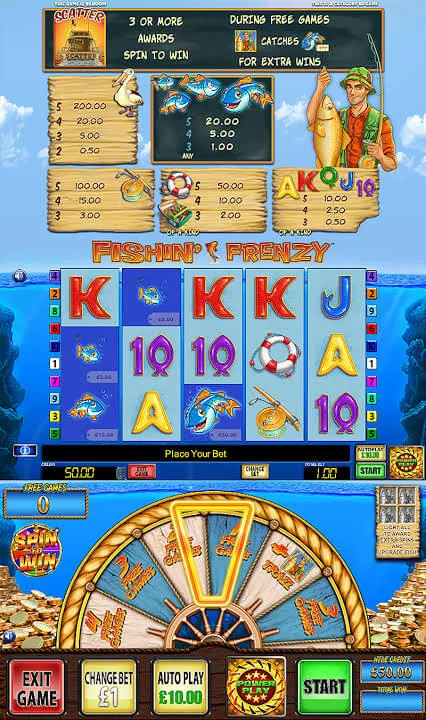
Blueprint Gaming's Fishin Frenzy pays back 96.12% over millions of spins — which means the house keeps £3.88 from every £100 wagered, forever. That 3.88% edge compounds fast when you're spinning every few seconds, and medium volatility guarantees you'll hit long stretches where the boat scatter refuses to land and your balance just bleeds.
This is the guide for players who want to understand exactly where the risk sits before they put a debit card into a UKGC-licensed casino. We'll walk through the mechanics, the legal framework in the UK, the difference between demo and real-money play, and the mistakes that turn a £20 flutter into a £200 regret.
Blueprint Built a Slot Around One Mechanic — and It Rarely Triggers
Fishin Frenzy runs on a 5-reel, 3-row grid with 10 fixed paylines. The base game is deliberately quiet: low-value playing-card symbols, a few fish carrying modest credits, and a wild fisherman who does nothing at all until you trigger the bonus. You're waiting for three or more boat scatters to land anywhere on the reels, which awards 10 free spins.
During those free spins, every fish symbol that lands displays a cash value. When the fisherman wild appears, he collects every fish on screen in one go — and that's when the multiplier stacks up. The theoretical maximum win is £250,000 per game round, capped by UKGC rules regardless of your stake.
The problem: three scatters might not land for 150 spins. Medium volatility means the game doesn't hit as hard as a high-variance slot, but it also doesn't pay often enough to keep your balance stable. You'll burn through £15 to £50 waiting for a feature that might award £3.
What the Numbers Mean When You're Sitting at the Lobby
RTP is a long-run average across millions of spins. In a single session, you're far more likely to see 85% or 110% return than exactly 96.12%. The house edge of 3.88% guarantees the operator wins over time, not that you lose every sit-down.
The £5 stake cap applies to every player in the UK except those aged 18 to 24, who face a £2 limit. If you're spinning at £5 a go and the feature doesn't hit for 200 spins, you've spent £1,000 chasing a bonus that might pay £40. That's the shape of medium volatility.
Where to Play Legally — and How the UKGC Licence Protects You
Every casino serving British players must hold a current UK Gambling Commission remote licence. The licence number sits in the footer of the site; you can look it up in the UKGC public register to confirm the operator is legitimate and that the licence hasn't been suspended.
UKGC-licensed sites are required to offer deposit limits, activity statements, and self-exclusion through GAMSTOP. If you register with GAMSTOP, one form blocks every licensed operator for six months to five years. Unlicensed sites — often called «offshore casinos» — don't appear in GAMSTOP, don't hold your funds in segregated accounts, and can refuse to pay out without legal recourse.
| Example casino | Licence check | Withdrawal speed | Stake caps | |
|---|---|---|---|---|
| bet365 Casino | UKGC register, licence in footer | 24 h to bank via Faster Payments | £5 / £2 by age | → |
| Sky Vegas | UKGC register, licence in footer | Same day to e-wallet | £5 / £2 by age | → |
| Grosvenor Casino | UKGC register, licence in footer | 1–2 working days to debit card | £5 / £2 by age | → |
Affordability checks kick in from £150 net deposits per month. The operator will ask for proof of income using credit-reference data at the first stage, then bank statements or payslips if you deposit more. It's intrusive, it's mandatory, and it exists because the regulator wants to catch problem gambling before someone bets the rent.
Demo vs. Real Money: the Difference Is Painful
Most UKGC-licensed casinos offer Fishin Frenzy in demo mode, though many require you to log in and verify your age before free play unlocks. Demo gives you a pretend balance — usually £100 or £1,000 in fake credits — and lets you spin without risking your own money.
The RNG is identical between demo and real-money play; Blueprint doesn't rig the demo to hit more often. What changes is your behaviour. In demo, you'll chase a losing streak for 500 spins because there's no consequence. In real money, that same streak costs £50, and you feel every spin that doesn't trigger the boat scatter.
- Demo lets you learn the paytable, test stake sizes, and see how long a £20 deposit might last at £0.20 per spin.
- Real money adds KYC (proof of identity and address before your first withdrawal), deposit limits, and a 24- to 48-hour document check that delays your first payout.
- Winnings in demo vanish the moment you refresh the page; real winnings sit in your casino balance, subject to wager requirements if you claimed a bonus.
Use demo to decide whether the game suits you. If 200 spins in demo feels dull, real money won't make it exciting — it'll just make it expensive.
Five Mistakes Everyone Makes in the First Week
- Chasing the feature: You've gone 180 spins without three scatters, so you convince yourself the next ten spins must hit. They won't. The RNG has no memory, and every spin is independent. Walk away or accept that you're paying for entertainment, not chasing a statistical correction that doesn't exist.
- Ignoring the wager requirement: A £10 deposit with a 100% match and 40× wagering means you must stake £800 before you can withdraw a penny. Fishin Frenzy's medium volatility makes it nearly impossible to clear a high wager without topping up your balance multiple times.
- Jumping straight to £5 spins: The maximum stake feels like the fastest route to the big win, but at £5 a spin, 100 dead spins cost £500. Start at £0.20 or £0.50, learn the rhythm, and only raise the stake when you're comfortable losing it.
- Assuming the fisherman collects on every free spin: He's a wild, and he only lands when the RNG says so. You might trigger 10 free spins, see fish symbols on every spin, and have the fisherman appear once — collecting £1.40. That's not a glitch; that's medium volatility working exactly as designed.
- Using a credit card or someone else's debit card: Credit cards have been banned for online gambling in the UK since April 2020, and using a payment method in another person's name will get your account frozen and your balance confiscated during KYC checks. Faster Payments from your own bank account or PayPal in your own name — nothing else.
Payment, Withdrawal, and the 48-Hour Wait You Didn't Expect
Deposits via debit card (Visa or Mastercard), PayPal, Apple Pay, or Trustly land instantly. You'll stake within seconds. Withdrawals move slower, especially the first time.
- E-wallets (PayPal, Skrill): a few hours to 24 hours once KYC is cleared.
- Faster Payments to your bank: same day to two working days.
- Debit card: one to three working days.
Before your first withdrawal, the operator will ask for a photo ID (passport or driving licence), proof of address (bank statement or utility bill dated within three months), and sometimes a selfie holding your ID. This is a legal requirement under anti-money-laundering rules, not the casino being awkward. Budget 24 to 48 hours for document review.
Gambling winnings are tax-free for the player in the UK. The operator pays Remote Gaming Duty, which jumped to 40% in April, but that's their problem, not yours. You keep every penny you withdraw, minus any fees your bank charges for currency conversion if you've somehow ended up playing in euros (which you shouldn't on a UKGC site).
A Short Glossary — What the Terms Actually Mean
- RTP (Return to Player): The percentage of all stakes the game pays back over millions of spins. 96.12% means the house keeps 3.88%. You will not see this number in a single session.
- Volatility: How the game pays. Low volatility pays small wins often; high volatility pays rarely but bigger; medium sits in the middle and guarantees long losing streaks.
- Scatter: A symbol that pays or triggers a feature regardless of payline position. In Fishin Frenzy, three boat scatters anywhere award 10 free spins.
- Wild: A symbol that substitutes for others to complete a winning line. In Fishin Frenzy, the fisherman is wild and also collects fish values during free spins.
- Wager requirement: The amount you must stake before you can withdraw bonus winnings. 40× a £10 bonus means £400 in total stakes, not £400 in wins.
- GAMSTOP: A free national self-exclusion scheme that blocks every UKGC-licensed site for six months to five years. Register at gamstop.co.uk.
- KYC (Know Your Customer): Identity and address checks required by law before your first withdrawal. Expect to upload a photo ID and proof of address.
FAQ
Can I play Fishin Frenzy for free without signing up?
Some UKGC-licensed casinos allow demo play before login, but most require you to create an account and verify your age first. The demo uses the same RNG and RTP as real-money play — it's not rigged to pay more often — but you can't withdraw pretend winnings, and your session resets when you close the browser.
Why does the fisherman never collect during my free spins?
The fisherman is a wild symbol, and he only lands when the RNG decides. You might trigger 10 free spins and see him once, or not at all. Fish symbols appear independently of the fisherman, so you can have a screen full of fish and zero collections. That's medium volatility: the big wins are possible but rare.
Is the £250,000 cap real, and how does it work?
Yes. UKGC rules cap the maximum win per game round at £250,000 for slots, regardless of your stake. If you bet £5 and hit a combination worth 60,000×, you'll receive £250,000, not £300,000. The cap exists to limit operator liability and is enforced across every licensed site.
What happens if I register with GAMSTOP and then want to play again?
You can't. GAMSTOP locks you out of every UKGC-licensed casino for the period you chose: six months, one year, or five years. There's no early opt-out, no exceptions, and no appeals. If you exclude for five years, you'll wait five years. Sites that let you bypass GAMSTOP are unlicensed, illegal to advertise in the UK, and hold no legal obligation to pay you.